3BI: Humanities, art vs science, and writing to think
Welcome to my 3BI newsletter, where I share three insights from the world of behavioral science on psychology, decision-making, and behavioral change.
Did someone forward this newsletter to you? Sign up here to have every new edition delivered straight to your inbox.
Demand for humanities education is rising

For much of the last decade, career advice for young people has pushed them to focus on STEM (science, technology, engineering, and mathematics) related subjects that build tangible skills for well-paying and stable jobs. As a result, enrollment and funding for fields like computer science and finance have grown while liberal arts subjects have shrunk.
That tide may be shifting, though, according to an analysis of labor market outcomes of recent college graduates by the Federal Reserve Bank of New York. From CNBC:
Majors in nutrition, art history and philosophy all outperformed STEM fields when it comes to employment prospects...
For computer science and computer engineering, the unemployment rate in those fields was 6.1% and 7.5%, respectively — notably higher than the national average.
By comparison, the unemployment rate for art history majors was 3%, and for nutritional sciences, the unemployment rate was just 0.4%...
STEM majors still command the highest starting salaries, particularly, in computer science or computer engineering, but are finding fewer employment opportunities. This likely reflects labor market changes in big STEM fields like technology, but also a general shift in recruiting strategy:
At a conference last year, Robert Goldstein, the chief operating officer of BlackRock, the world’s biggest money manager, said the firm was adjusting its hiring strategy for recent grads. “We have more and more conviction that we need people who majored in history, in English, and things that have nothing to do with finance or technology,” Goldstein said.
This demand for liberal arts degrees is due in part to the rise of artificial intelligence, which drives the need for creative thinking and so-called soft skills.
AI is obviously a factor, as computers can increasingly handle more technical and mathematical tasks, but I think it also reflects a general need for more creative thinking and unique perspectives. AI increases the value of the human premium, but perhaps an overemphasis on analytical studies has led to an oversupply of rigid thinking that needs counterbalancing, as well.
Art and science have to be balanced
Part of the reason for this rigid thinking is that an explosion of data collection from digital tools in the last 20 years created a culture of analytics and hyper optimization. This emphasis on measurement and precision put creative, humanistic approaches in the back seat. Even more creative fields like advertising have become focused more on data-driven efforts like digital advertising than creative copy and design.
Data can create an illusion of certainty, though, and stifle real creativity. From John Ganz:
A huge problem with the modern world, if you’ll permit me, is a confusion between arts and sciences: people try to apply scientific principles to the arts, and vice versa, with the result being a giant muddle.
I think the shift in recruiting strategy mentioned above reflects a recognition of this. Leaders are slowly realizing that not everything can be measured accurately and the world is more random and unpredictable than what can be captured in predictive models.
Perhaps we’ve been overemphasizing science and are now shifting to balance it more evenly with art.
Thinking is an important part of science
One part of that balance is that good scientific work requires creative thinking as much as technical skills. From Writing is thinking, on the value of creative thinking and writing in the era of LLM’s:
Writing scientific articles is an integral part of the scientific method and common practice to communicate research findings. However, writing is not only about reporting results; it also provides a tool to uncover new thoughts and ideas. Writing compels us to think — not in the chaotic, non-linear way our minds typically wander, but in a structured, intentional manner. By writing it down, we can sort years of research, data and analysis into an actual story, thereby identifying our main message and the influence of our work. This is not merely a philosophical observation; it is backed by scientific evidence. For example, handwriting can lead to widespread brain connectivity and has positive effects on learning and memory.
…
All that is not to say LLMs cannot serve as valuable tools in scientific writing…Nevertheless, outsourcing the entire writing process to LLMs may deprive us of the opportunity to reflect on our field and engage in the creative, essential task of shaping research findings into a compelling narrative — a skill that is certainly important beyond scholarly writing and publishing.
Other stuff
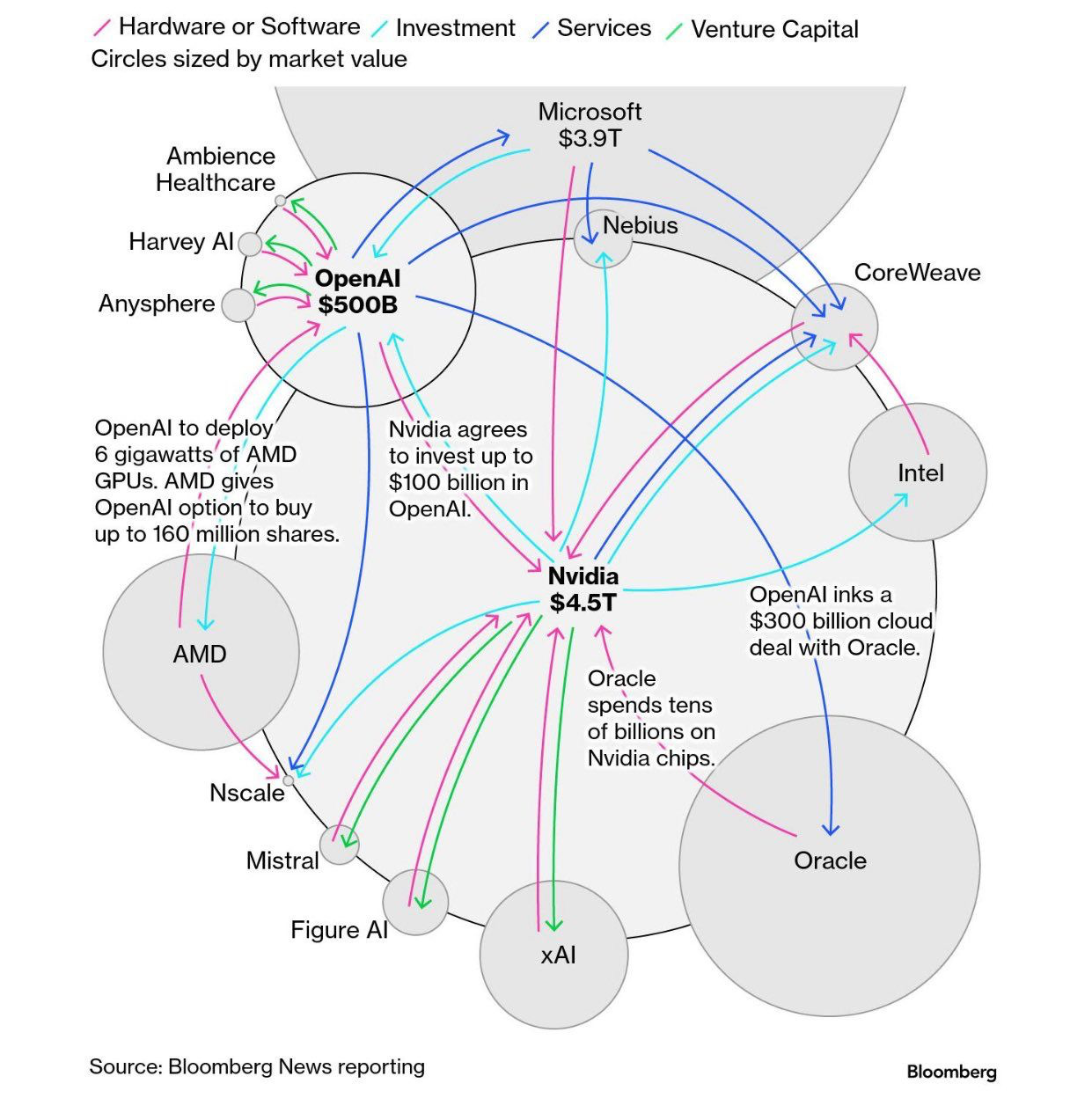
A great chart from Bloomberg on the circular nature of the AI boom: